

Simultaneous filing of I-130 and I-485 petitions for relatives: The complete path for a U.S. citizen to apply for a green card for their parents.
Background Strength: Five Stars ★★★★★
A U.S. citizen applied for green cards for his parents, submitting I-130 and I-485 applications simultaneously. During the process, he obtained an Employment Authorization Document (EAD) and a Reentry Permit, and the application was successfully approved in 2.5 months.

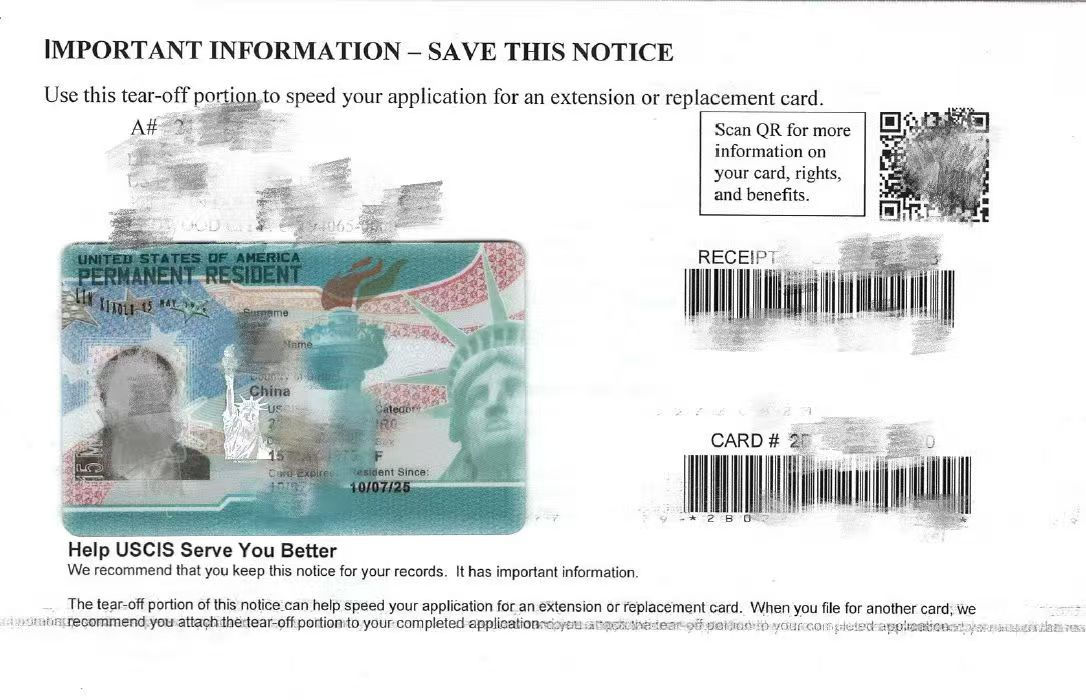

For cases involving parents, whether they can be filed "at the same time" is the key factor determining the speed of the process.
Client Background
Mr. Zhang, a U.S. citizen who has been a naturalized citizen for many years, had parents who were visiting the U.S. on B-2 visas and hoped to stay and live with their son in their old age. Mr. Zhang's request was straightforward: could he complete the green card process within the U.S. without his parents having to return to China and wait for processing times?
Step 1: Confirm the status of "immediate family member" to secure eligibility for simultaneous applications.
One of the most confusing aspects of family-based immigration is that not all family-based categories allow simultaneous filing of I-130 and I-485 petitions. Spouses, unmarried children under 21, and parents of U.S. citizens are considered "immediate relatives" and are not subject to annual visa quotas; their visa numbers are always readily available. Therefore, as long as the parents are legally in the U.S. and have no serious legal issues, they can file their I-485 petitions together with the I-130 petition before it is approved, unlike siblings and married children who fall under "family preference" categories and are stuck on the visa bulletin. Mr. Zhang's parents legally entered the U.S. on B-2 visas and meet the requirements, so we proceeded with the simultaneous filing approach.
Step 2: Prepare materials simultaneously and submit them all at once.
Submitting simultaneously means that all materials must be prepared at once: I-130 proof of kinship (birth certificate, notarized and authenticated documents), I-485 adjustment of status application, I-864 Affidavit of Support (proving Mr. Zhang's ability to support his parents' financial responsibilities while they are in the U.S.), and the medical examination report (I-693) that must be submitted with the I-485 under the new regulations. We also submitted the I-765 Employment Authorization Document (EAD) and I-131 Reentry Permit at the same time, so that the materials were packaged together to avoid delays caused by missing items and subsequent requests for additional documents.
Step 3: Work permit and reentry permit during the waiting period
After the case entered the review stage, the work permit and reentry permit were approved within a few weeks. They were issued as a single card, allowing Mr. Zhang's parents to legally remain in the United States while waiting for the green card results, without affecting their normal travel arrangements. They were not completely restricted from their lives by the rule that "the case cannot be moved until it is approved."
Step 4: Medical examination, interview, and final approval
After all the required documents were submitted, Mr. Zhang's parents completed the medical examinations with the designated doctor as instructed, and then participated in an interview with the immigration office, which mainly verified the authenticity of their kinship and the consistency of the documents. Following a successful interview, their green cards were quickly approved.
result
From submitting the application to finally receiving the green card, Mr. Zhang's parents completed the entire process within the United States, without experiencing the hassle of "returning to China for a waiting period and then re-entering the country." When the green card was approved, the family was reunited, instead of waiting for news across the Pacific Ocean.
The biggest takeaway from this case is that in family-based immigration, determining whether the beneficiary is an "immediate family member" and whether they can submit applications simultaneously directly determines whether the entire case is processed "monthly" or "annually"—getting this eligibility assessment right is more crucial than the subsequent document preparation itself.
[2026 Policy Update and Supplement]
On May 21, 2026, the USCIS issued a significant policy memorandum (PM-602-0199) that changed the classification of "Adjustment of Status within the U.S." (I-485) from a routine administrative procedure to **"unconventional discretionary relief"** . This means that even if an applicant meets all the legal requirements, USCIS officers are now required to actively seek reasons for denial, rather than approving it simply because the conditions are met. The memorandum explicitly states a crucial point: "The absence of negative factors is insufficient to demonstrate the existence of positive balancing factors that warrant approval." In other words, "I didn't do anything wrong" is no longer enough; applicants must demonstrate tangible advantages (such as a close family relationship with a U.S. citizen child, a long-term legal residency record, or good character).
The highest-risk groups under this new policy include: those who have overstayed their visas on B-1/B-2 or F-1 visas; those who have been granted parole but have not left by the due date; and those deemed to have "intended to apply for a green card beforehand" upon entry (this is especially important for parents visiting relatives on tourist visas and subsequently adjusting their status). More importantly, if an I-485 application is denied and the applicant has no other valid status, the USCIS will now directly initiate a deportation action (NTA) , a risk that is on a completely different scale from the past where "if denied, you can simply maintain your original status."
This is why "advising parents to return to their home country to process the visa" is actually safer in certain circumstances : If the parents' situation involves the risk factors mentioned above (such as an overstayed visitor visa, or a discrepancy between the purpose of entry and the actual behavior), attempting to adjust their status within the US could lead to deportation proceedings if refused. However, if they opt for consular processing, which involves returning to their home country to process the visa at the US consulate, even if the application materials are flawed and the application is refused, the consequence is simply "not getting a visa this time," and they will remain abroad and not be involved in US deportation proceedings.
It's important to note that this isn't a blanket statement that "it's better to handle everything back in China" :
If the parents have a clean entry record, have not overstayed their visas, and have not violated any immigration rules, adjusting their status within the country remains a more conventional and advantageous path—firstly, they do not need to leave the country, and secondly, they can obtain their work permit and reentry permit simultaneously during the processing period, which are conveniences that consular procedures do not offer.
Before choosing to return to your home country to process the application, you must first check whether you have triggered any issues related to "unlawful presence" that could result in a 3-year or 10-year ban from entering the country. Otherwise, returning to your home country to process the application may result in you being stuck abroad and unable to leave.
Not everyone meets the eligibility criteria for consular processing; the specific approach will depend on a case-by-case assessment.
Therefore, the accurate statement is: if the parents' situation involves risks such as overstaying their visas or doubts about their purpose of entry, then going through the consulate process under the new policy in 2026 is indeed relatively safer; however, in normal circumstances without these risks, submitting I-130/I-485 applications simultaneously within the country remains a more efficient option . It is recommended to conduct a risk assessment before making a specific choice.
Sources:
USCIS Issues Guidance Regarding Family-Based Immigration Policy
USCIS Memo on Adjustment of Status: Family Applicants - Boundless